
Sound familiar?
The china cabinet nobody talks about
- Your daughter told you, kindly, that she has no room for twelve place settings.
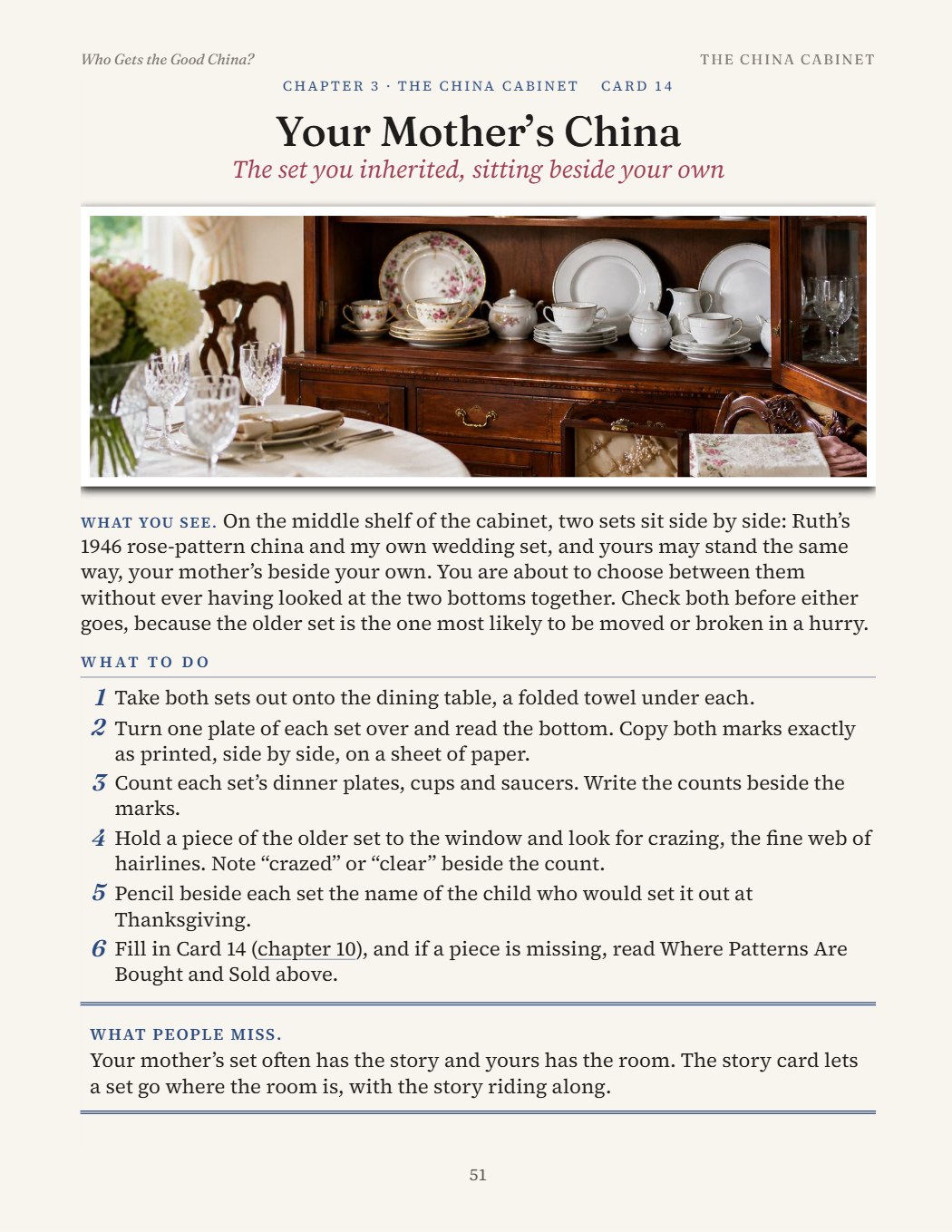
- You hold your mother’s china next to your own, and you can’t bear to picture either one at Goodwill.
- Every holiday somebody asks who gets what, and everybody changes the subject.
- You’ve been saving the good china for good, and good never seems to come.
- You’ve heard it all said: it’s worthless, nobody wants it, it’s just stuff.
It isn’t your fault, and it isn’t too late. Nobody ever showed you a way to hand things down with their stories. That’s what this workbook is.
What you were told, and what works instead
“Just make a list of who gets what.”
A list says who, not why. My mother’s was found with half the names gone. Each piece gets a card: whose hands it was in, the story, who gets it and why. p. 171
“Get the kids together at Thanksgiving and let them pick.”
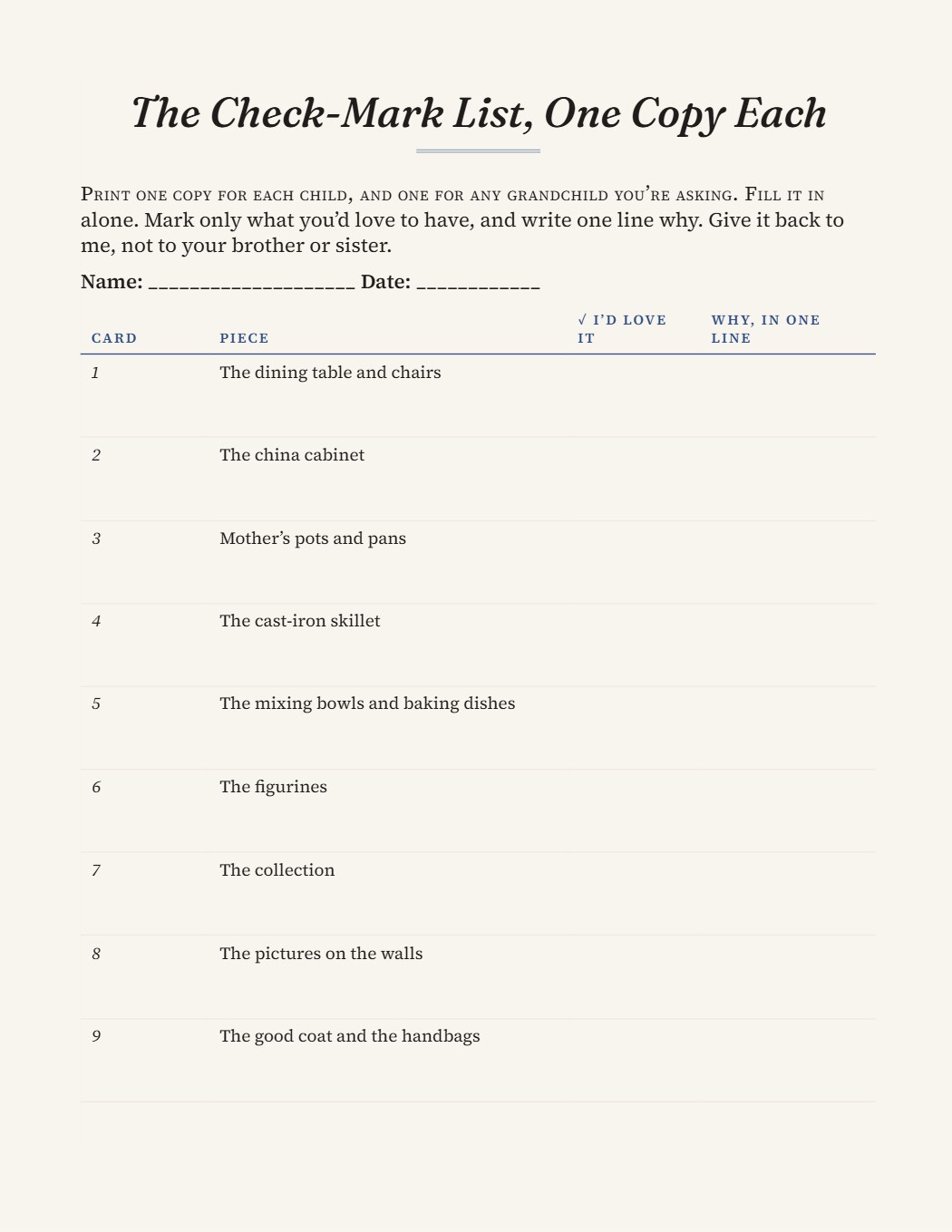
Nobody answers honestly in front of a sister. Ask each child alone, with their own copy of the list and one line why beside every check mark. p. 257
“Save the good china for good.”
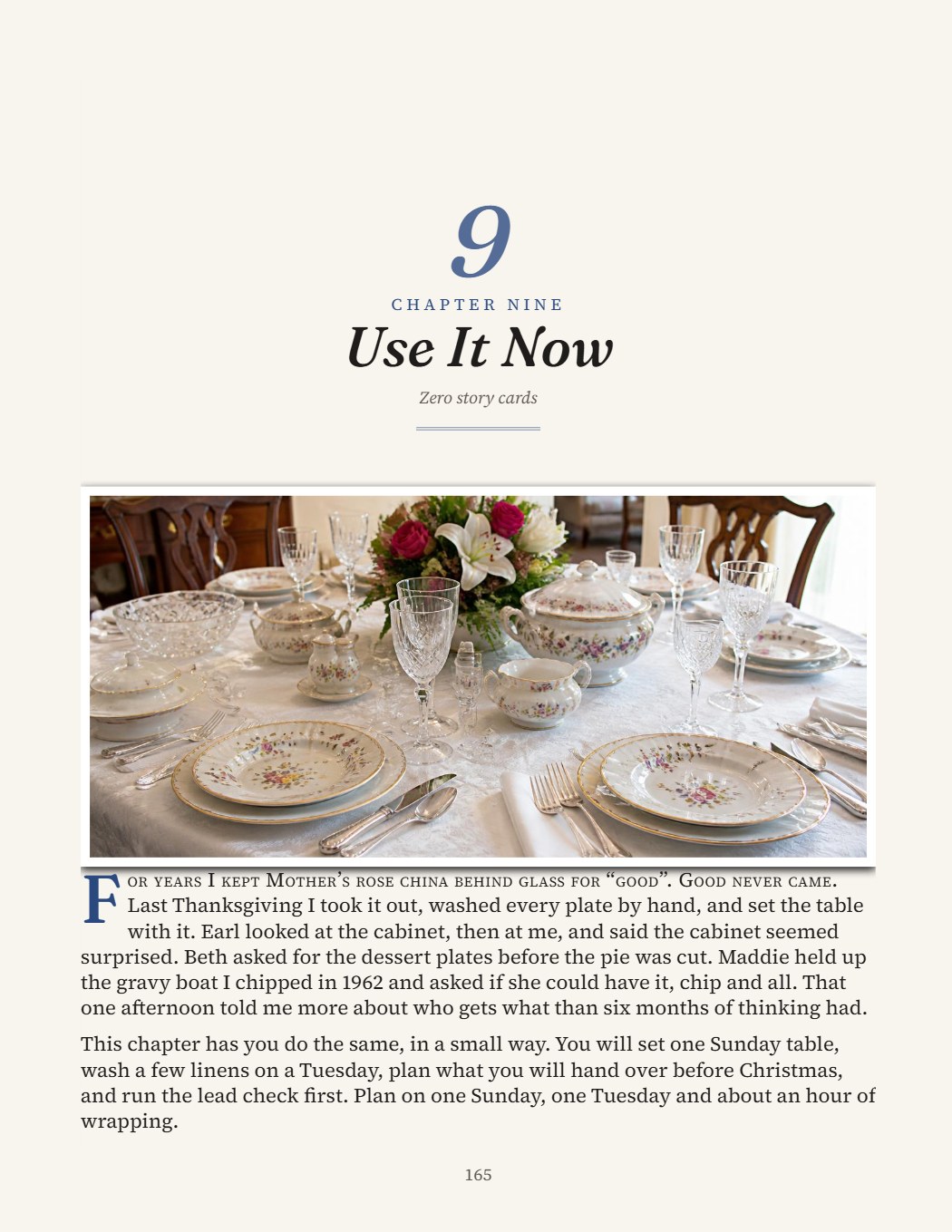
Set one Sunday table with it, after the lead check. One afternoon at that table told me more about who gets what than six months of thinking. p. 165
“Nobody wants it. Call the dealer.”
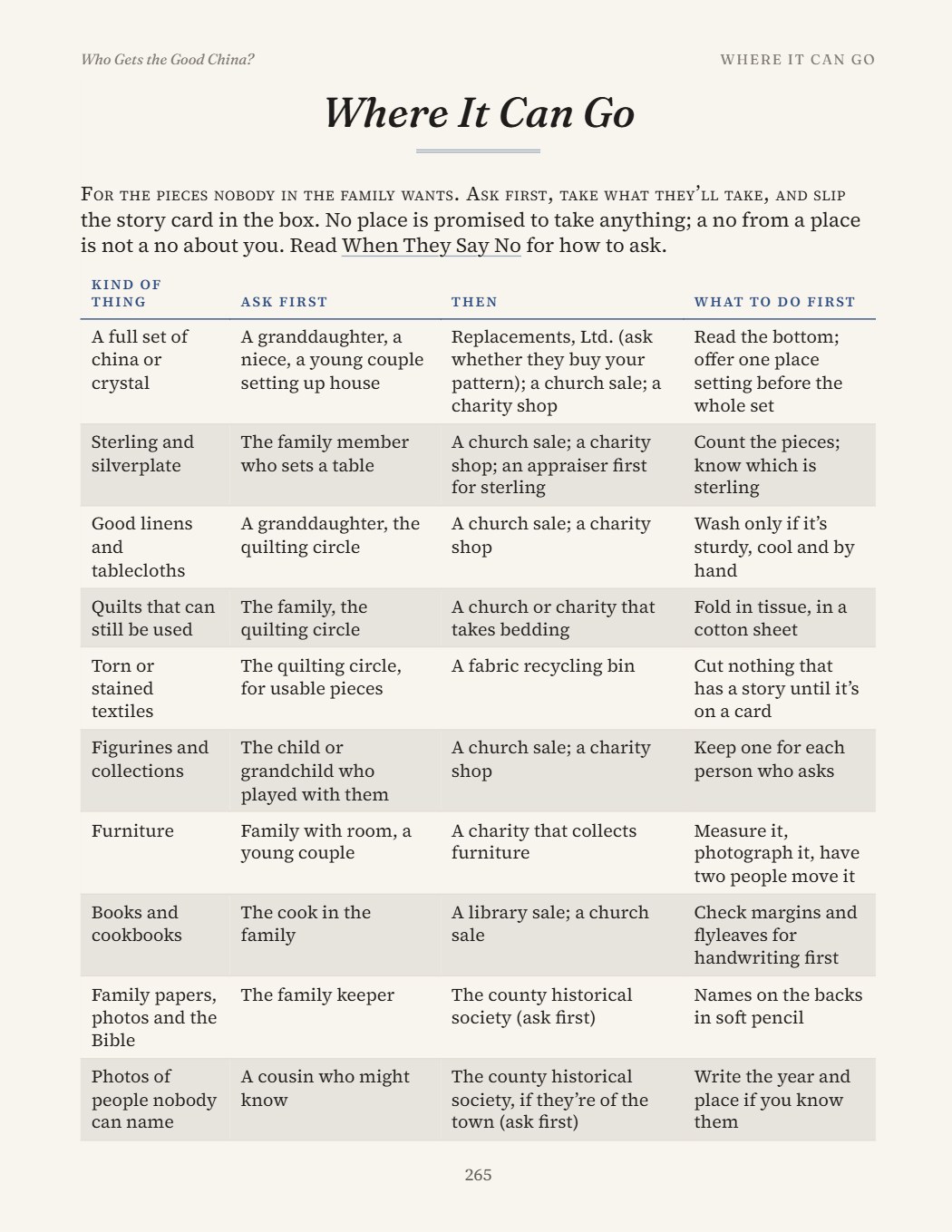
Nobody wants twelve of everything. One cup for a granddaughter, the linens for the quilting circle, somewhere better than the dumpster for the rest. p. 265
“I won’t care, I’ll be gone.”
Your children will, the Saturday they stand in a cold house guessing. One folder, and two people who know where it is. p. 234
The math
One house, two ways
Left for the children, the way my mother’s was
- Weekends my sister and I spent clearing her house6
- Names on her list still livingHalf
- Pieces with their story written down0
- Arguments over things that didn’t matterOnce or twice
Decided by you, one room per Sunday
- Sundays, one room each9
- Time each SundayAbout 1 hour
- Story cards, one per piece60
- Talks with each child, aloneAbout 30 min
The whole house, decided by you, in about
9 Sunday hours
Not six weekends of your children guessing after you’re gone. The workbook is $27, once.
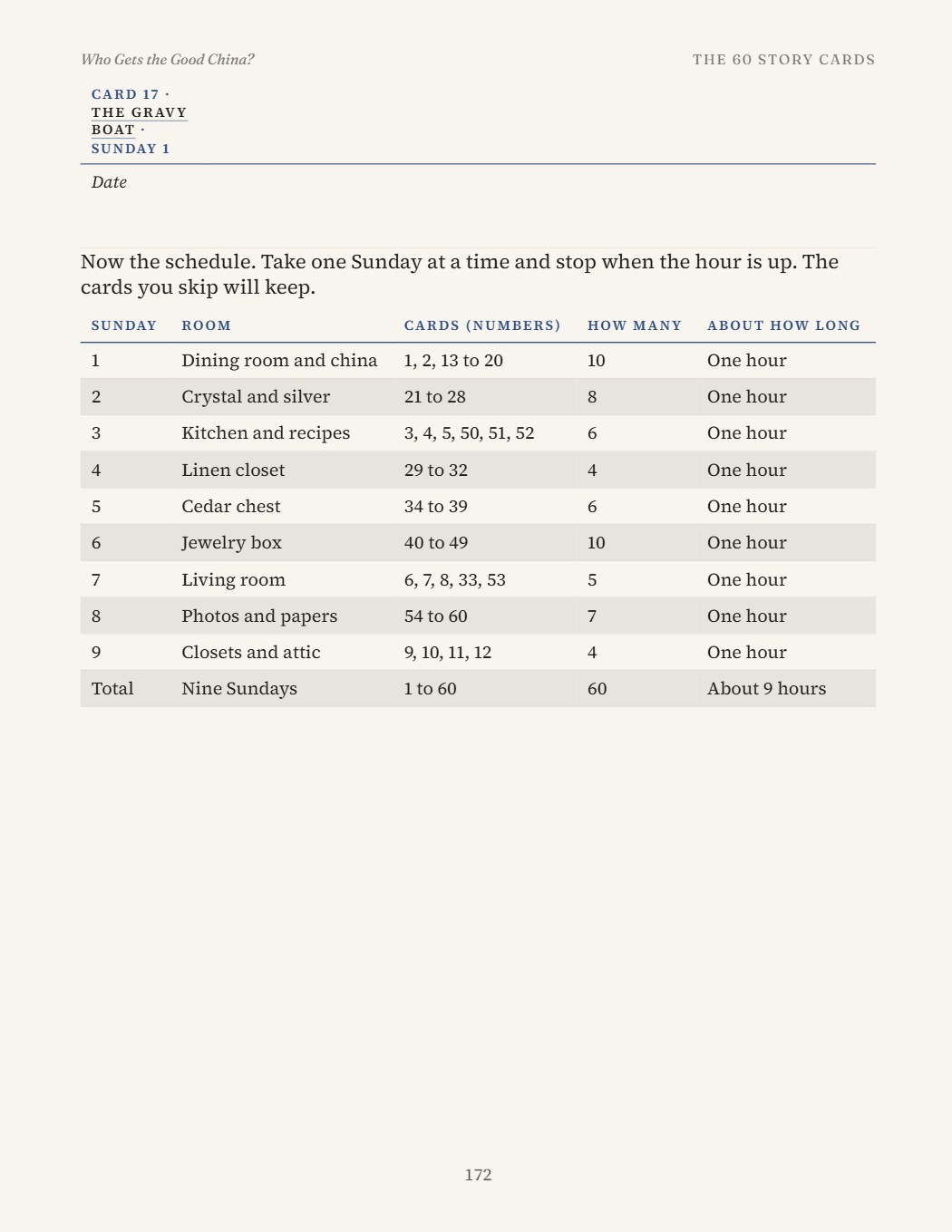
The left column is my own family: my sister and I cleared our mother’s house over six weekends in 2003 (page 10). The right column is the book’s schedule (page 171). Your house will differ; one room per Sunday is the pace, not a race.
Real pages from the workbook
Look inside
What’s inside
Who Gets the Good China? is the room-by-room way to decide who gets what, with 60 story cards to fill in and a list for each child.
| # | Chapter | Page |
|---|---|---|
| 1 | Before You Give Away a Single Plate. My three rules, reading the bottom of a piece, and your first Sunday | 10 |
| 2 | The Walk-Through, Room by Room. The rooms, the furniture and the collections, one entry per piece | 16 |
| 3 | The China Cabinet. Your china, your mother’s china, crystal and silver, piece by piece | 43 |
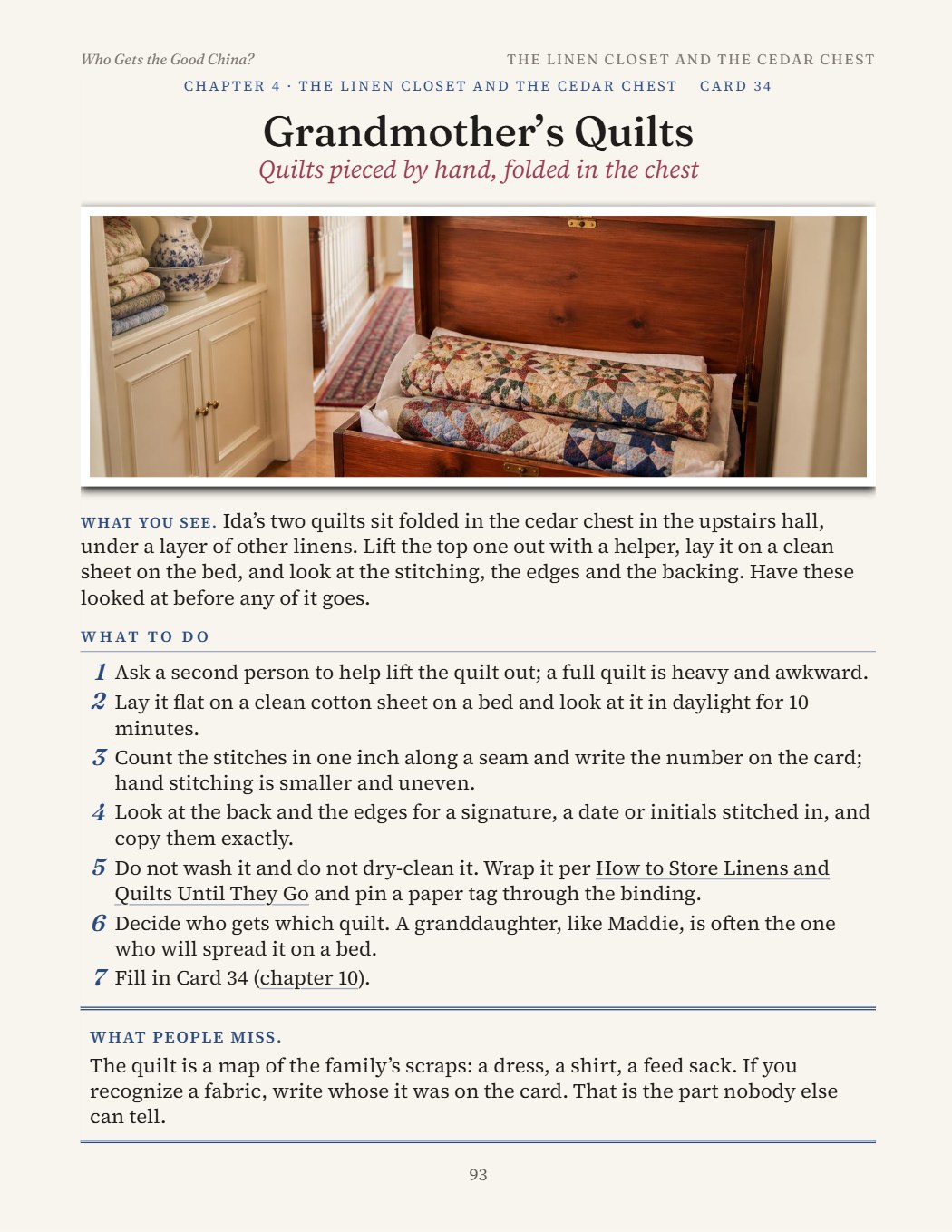
| 4 | The Linen Closet and the Cedar Chest. Linens, quilts, the wedding dress and the christening gown, stored right | 81 |
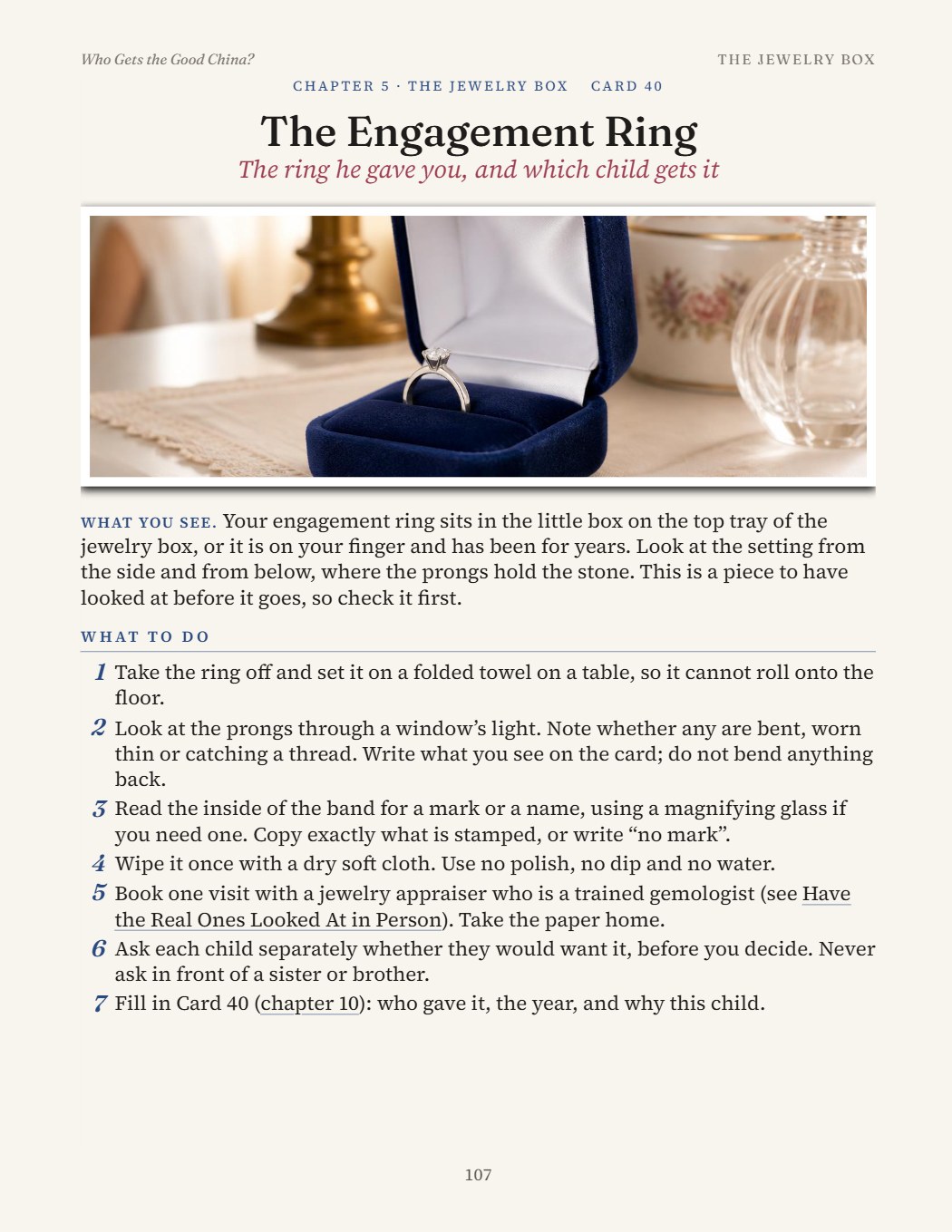
| 5 | The Jewelry Box. The ring, the cameo and the watch, and which child gets each | 105 |
| 6 | The Recipe Box, the Photos and the Letters. Recipes in three handwritings, the photo albums and the family Bible | 127 |
| 7 | Asking Each Child. Three questions, one child at a time, and what to do when two want the same thing | 154 |
| 8 | When They Say No. One piece instead of the whole set, and who else might want it | 160 |
| 9 | Use It Now. The Sunday table, the good linens, and the lead check first | 165 |
| 10 | The 60 Story Cards. My own card for the gravy boat, then 60 cards to fill in | 170 |
| 11 | If I Go First. Where everything is and what’s promised, for the one who stays | 234 |
| 12 | The Letter in the China Cabinet. One letter in your own words, with a fill-in guide | 241 |
| 13 | What I Leave to the Lawyer. What to gather before you see your attorney, and the questions to ask | 247 |
A few things you’ll find
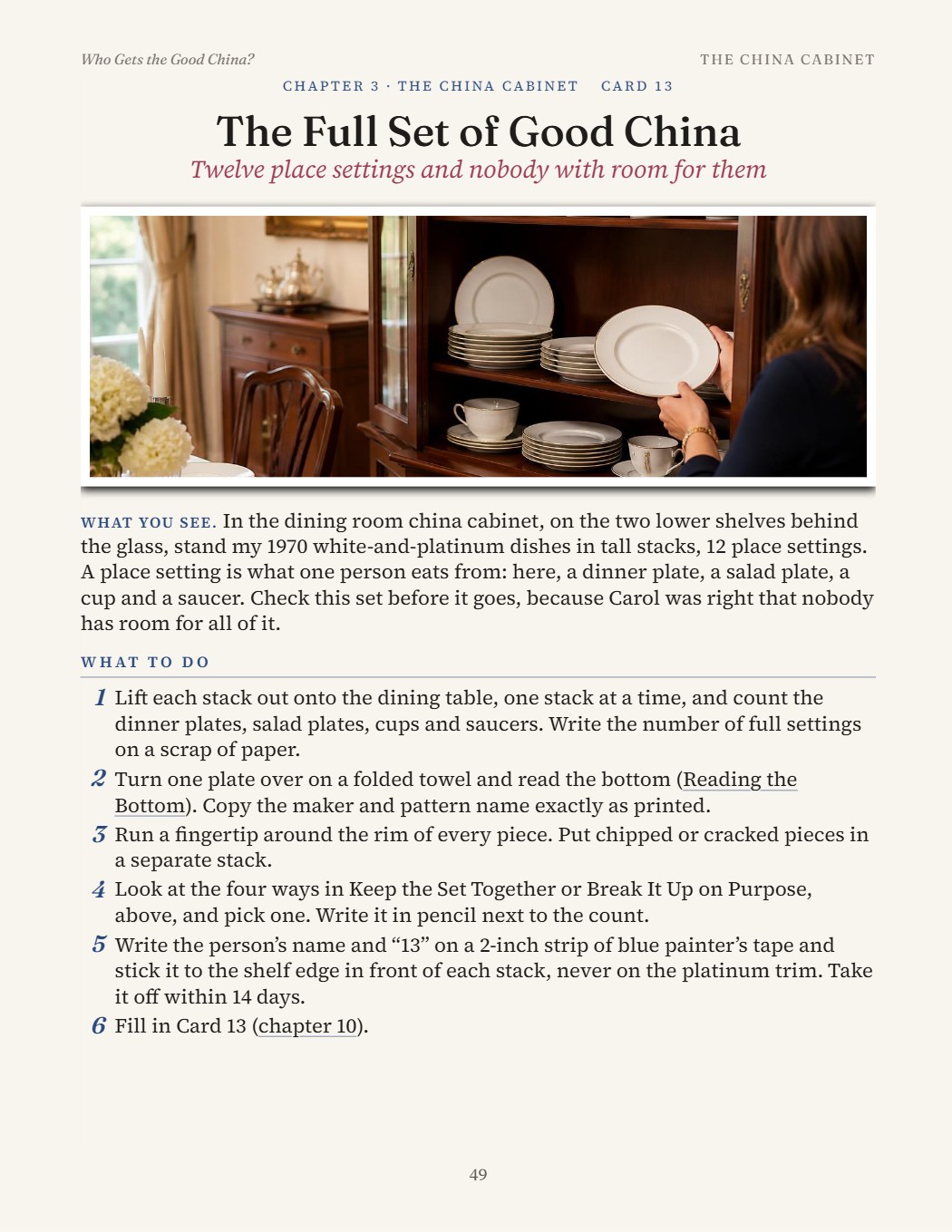
- Twelve place settings and nobody with room: keep the set, split it, or one eachp. 49
- The three questions to ask each child, alone, in orderp. 154
- What to do when two children want the same cameop. 154
- Where you never put tape on china, silver or a quiltp. 263
- The lead check to do before anyone eats off old chinap. 165
- Where the quilts and linens can go when the family says nop. 265
- The letter that goes in the china cabinetp. 241
- What to bring your attorney, so you’re not paying to sort teacupsp. 247
At the back: the nine Sundays on one page, the room-by-room checklist, one check-mark list for each child, a label sheet and the Where It Can Go table. Print them as often as you need.
How this book came about
Thirty springs at the rummage table

I was nineteen when I took the job at the china and silver counter of the big department store downtown. I ran its bridal registry for twenty-six years and helped hundreds of brides choose their china, crystal and silver.
For thirty springs I also ran the good things table at our church rummage sale. Every spring those same patterns came back to me, in grocery bags. Nobody knew whose table they had been on, or why they mattered.
In 2003 my sister Peg and I cleared our mother’s house over six weekends. In a drawer we found her list of who gets what. Half the names on it were already gone, and nothing on it said why.
Now I’m seventy-seven, and I’m deciding who gets my own things, one room at a time, with a story card for every piece. Last Thanksgiving I stopped saving Mother’s rose china and set the table with it. My granddaughter Maddie asked for the gravy boat, chip and all. This workbook is exactly how I’m doing it.
June Merrill
Who it’s for, and who it isn’t
It’s for you if
- You hold your mother’s or grandmother’s china, linens or jewelry next to your own.
- Your children have said they don’t want it, or you haven’t asked them yet.
- You’re downsizing, or thinking about it, and want to decide while it’s your call.
- You want the story to go with the thing, not just a name on a list.
- You’re a daughter clearing a parent’s house and want a fair, kind way through it.
It’s not for you if
- You want to know what your china is worth. The book prices nothing; it tells you who to ask, in person.
- You need a will, a trust or tax advice. That’s for your attorney, and chapter 13 helps you get ready.
- You want the whole house done in one weekend. This goes one room per Sunday.
No values, on purpose
I won’t guess what a piece is worth from a photograph, and you shouldn’t trust anyone who does. Where a value matters, the entry tells you who to ask in person.
Old dishes need a lead check
Pieces made before 1971 are very likely to contain lead. The book tells you how to test them before everyday food use, or keep them for display.
Get Who Gets the Good China?
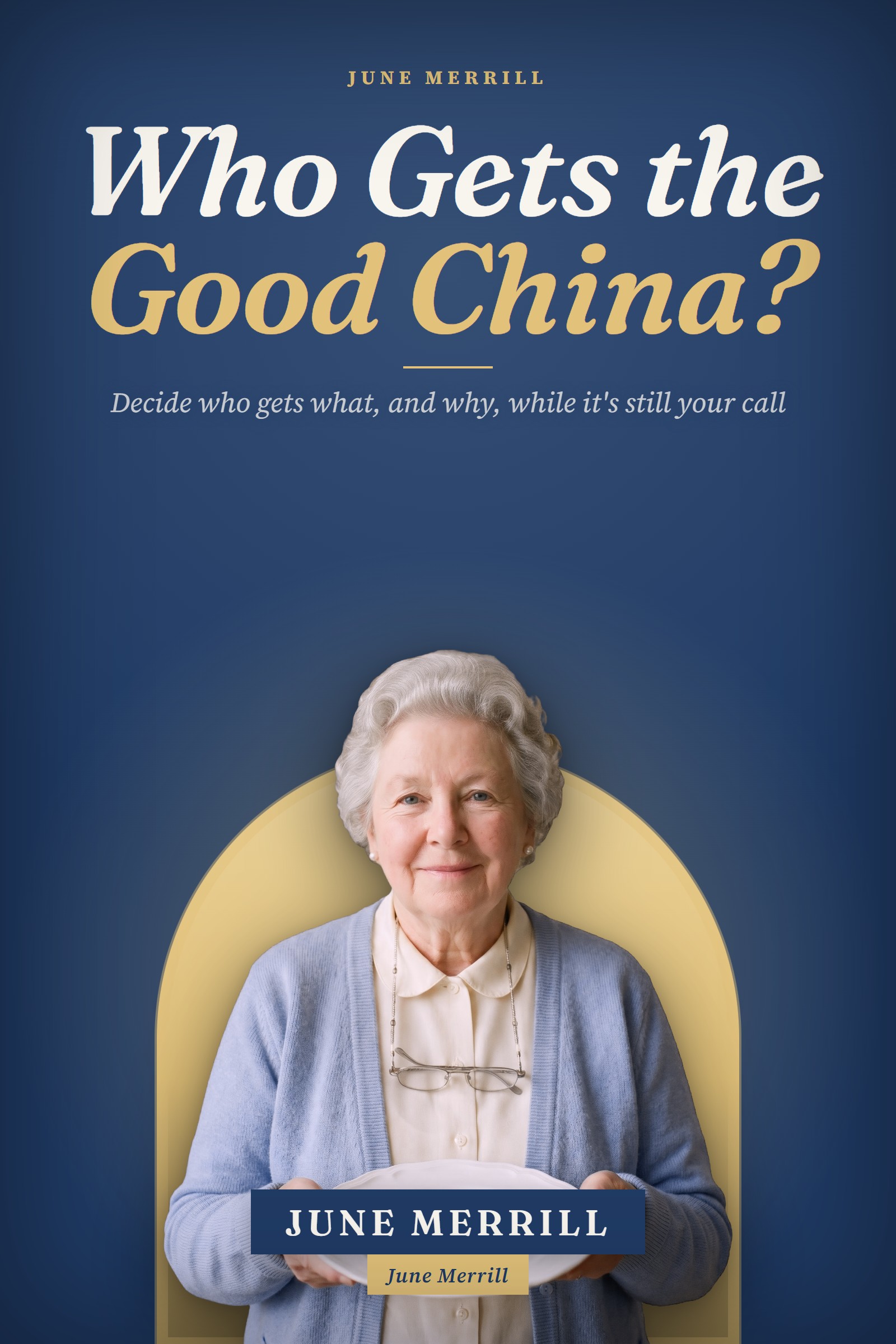
Who Gets the Good China?
- 60 fill-in story cards, one per piece, so the story goes with the thing
- The room-by-room walk-through, from the china cabinet to the cedar chest, so you always know what’s next
- A check-mark list for each child, so every child is asked fairly, and alone
- What to say when they say no, and the Where It Can Go table, so nothing ends up in a dumpster
- Use It Now, with the lead check, so the good china comes out this Sunday
- If I Go First and the letter for the china cabinet, so nobody finds your wishes by luck
- What to bring your attorney, so the appointment is short
- PDF and EPUB, and every fill-in page prints at home as often as you need
🔒 Secure checkout by Gumroad · Card · Apple Pay · Google Pay · PayPal
Right after you pay, the download page opens and the link comes to your email. Start with chapter 1 on page 10: an hour to read, and your first Sunday is planned.
The Sunday Promise
Use it for 30 days. If it doesn’t help you decide who gets what, write to me and you’ll get every penny back. No questions, and you keep the pages.
Questions you’ve asked me
Do I need a computer to use it?
Only to open it once. Print the pages you need, or have someone print them for you, and fill them in with a pen.
My kids say they don’t want any of it. Is it still for me?
Yes, most of all. Chapter 8 shrinks the ask to one piece and widens the circle to grandchildren and the quilting circle, and the Where It Can Go table finds a good place for the rest.
Will it tell me what my china is worth?
No, on purpose. It shows you how to read the bottom of each piece and who to ask for a real value, in person.
I’ve already given some things away. Is it too late?
No. Fill in a card for what’s left, and write the stories of what you gave so they go with it.
How do I keep it fair between my children?
Ask each one alone, with their own copy of the list and one line why beside every check mark. If two want the same piece, chapter 7 shows a fair way to settle it, written down.
Is this a legal document?
No. The cards and lists are for your family. Chapter 13 lists what to take to your attorney if you want something to have legal weight.
Can I use it to clear my mother’s house?
Yes. The room pages, the cards and the Where It Can Go table work the same way for a daughter clearing a parent’s house.
Why is there a clock on the price?
The launch price of $27 is held for you for 30 minutes from your first visit, long enough to read this page and ask your family. After that, the workbook is $37. The clock is real.
Start with one room this Sunday
Your good china is going to end up somewhere. Let it be where you chose, with the story that makes them keep it. 60 cards, one room at a time.
It’s not the dish. It’s whose hands it was in.
P.S. If you do only one thing this week, turn one plate over and write a name on its card. And if the workbook isn’t for you, every penny comes back.